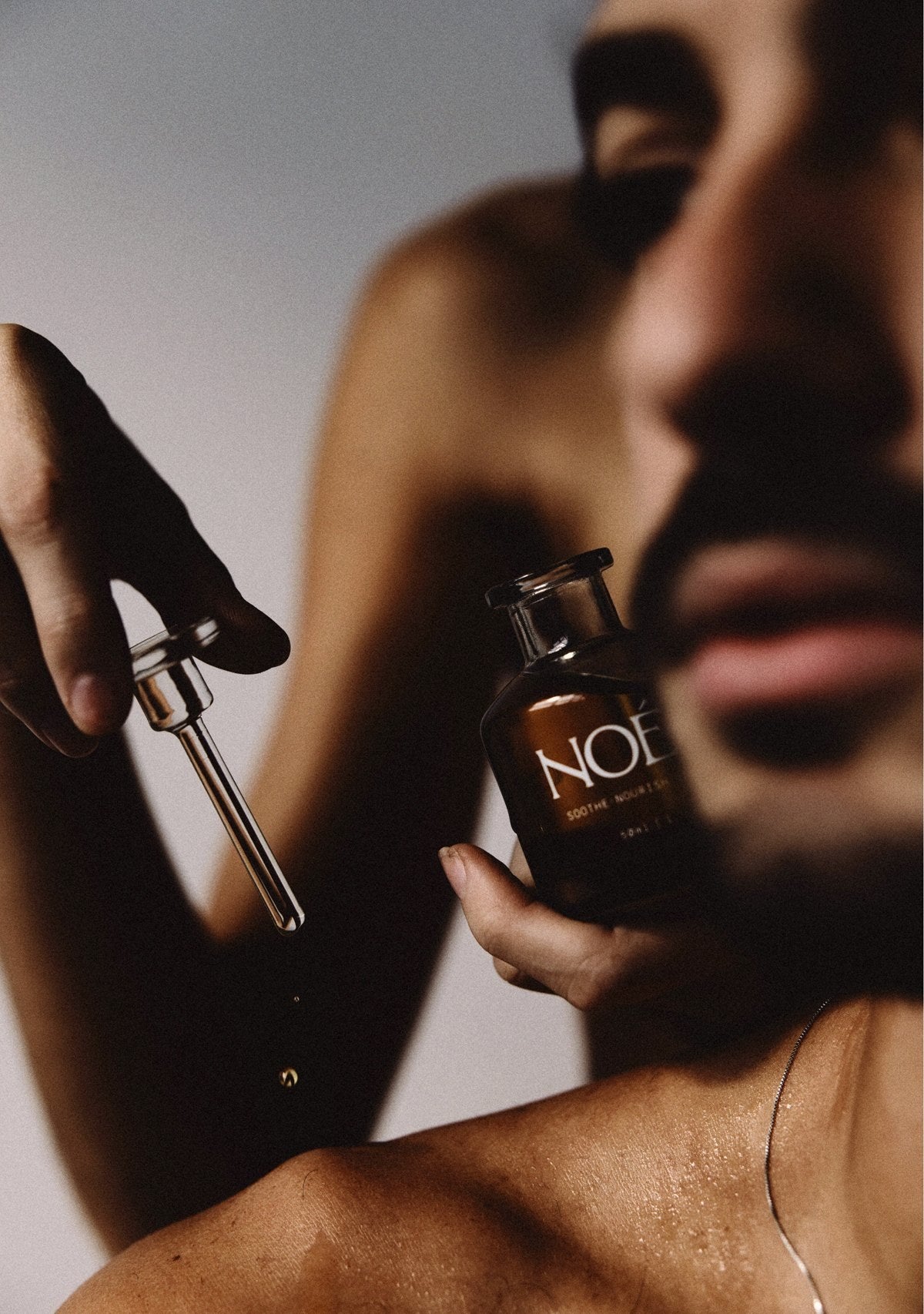
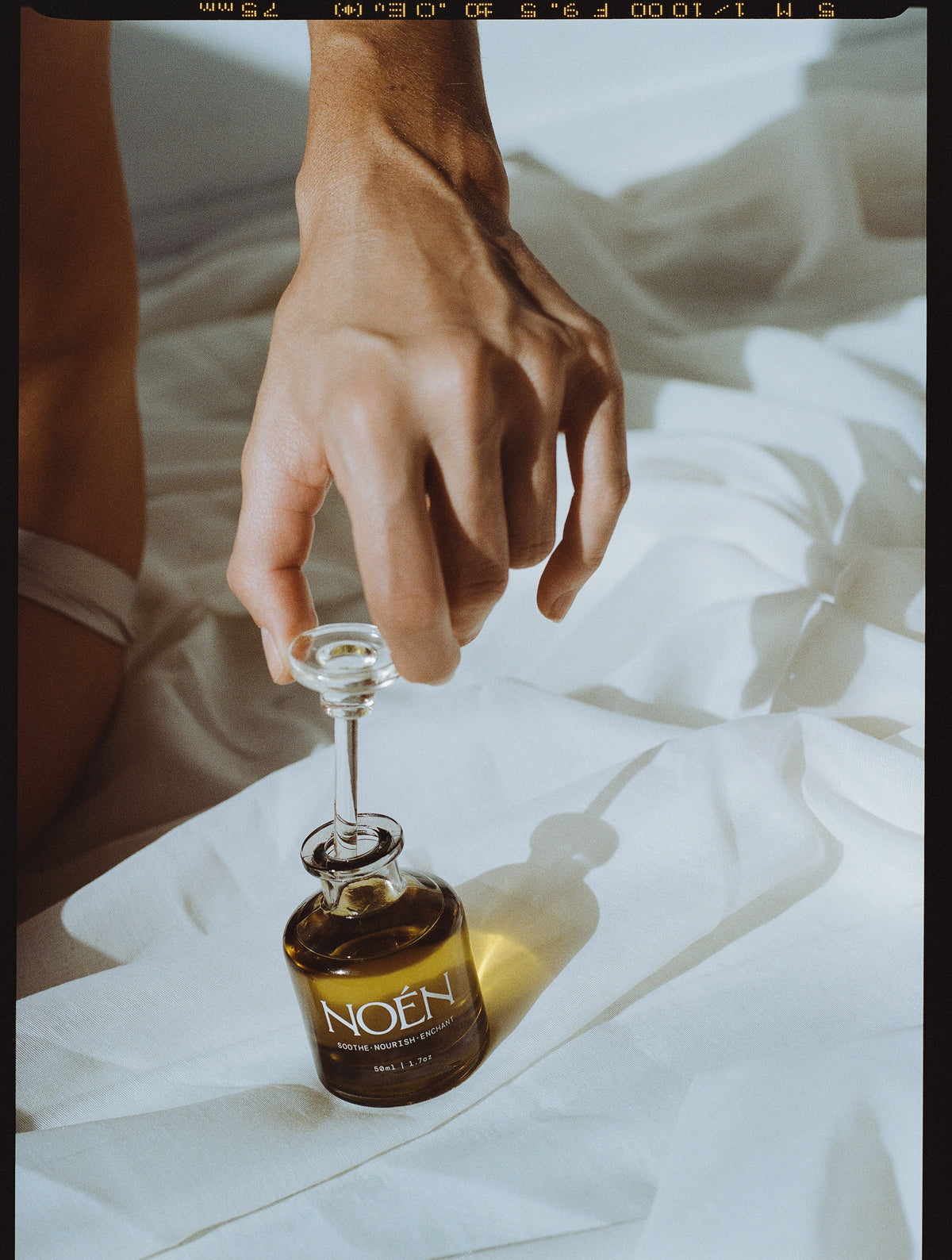
The Ritual of Anointing: Why One Oil is Enough
The ancient Egyptians didn't moisturize.
They anointed.
There's a difference. Moisturizing is maintenance—a task you complete so you can move on with your day. Anointing is presence. It's the act of honoring your body as something sacred, not something to fix.
When Cleopatra prepared for the day, she didn't reach for twelve bottles. She reached for one oil—pressed from plants that grew along the Nile, infused with blue lotus and myrrh—and used it everywhere. On her skin. In her hair. Before touch. After bathing. As offering. As adornment.
One oil. Infinite uses.
This wasn't about simplicity for the sake of convenience. It was about mastery. The Egyptians understood that luxury isn't accumulation—it's knowing what matters and doing it with full attention.
We've forgotten this.
How We Got Here: The Cult of Specialization
Walk into any modern bathroom and you'll find a small pharmacy: body lotion, hand cream, face serum, hair oil, massage oil, cuticle balm, lip treatment, foot cream. Each product promises to solve one specific problem. Each lives in its own bottle, expires on its own timeline, and costs its own $40.
The beauty industry taught us to specialize. One product per body part. One formula per concern. Twelve steps where one would do.
This isn't science. It's marketing.
The logic is circular: the more problems we're told we have, the more products we need to solve them. Dry elbows require elbow cream. Frizzy hair requires frizz serum. Rough cuticles require cuticle oil. Never mind that the same base ingredients—plant oils, botanical extracts, vitamins—appear in all of them, repackaged and repriced.
We've been conditioned to believe that complexity equals efficacy. That if we're not using seven products, we're not doing enough.
But the opposite is true.
The Return to Simplicity (Which Is Actually Mastery)
The Egyptians didn't have less. They had focus.
Anointing oils weren't a single product—they were a practice. The same oil that softened skin also conditioned hair, eased sore muscles, and heightened sensation during intimacy. It was used in temples as offering and in bedrooms as aphrodisiac. It marked transitions: birth, death, marriage, healing.
Oil was the constant. Context changed its meaning.
This is what we mean when we say ritual. Not adding steps. Not complicating the routine. But bringing full presence to the acts we already perform.
When you smooth oil over damp skin after a shower, you're not just hydrating. You're practicing embodiment. When you warm it between your palms before touching another person, you're not just creating slip. You're signaling: I'm here. I'm present. This matters.
The ritual isn't the oil. The ritual is the attention you bring to it.
Why Multi-Use Is More Luxurious, Not Less
There's a pervasive idea that luxury means specialization. That the more specific a product's use, the more premium it is. Eye cream that only goes on eyelids. Serum that only targets pores. Oil that only works on cuticles.
But true luxury is the opposite.
True luxury is a single thing, made so well, that it works everywhere.
Think of the world's most enduring luxury goods: a perfectly tailored coat that works for a decade. A cast-iron pan that does the work of five. A fragrance so well-composed it shifts with your skin chemistry and the time of day.
These aren't "jack of all trades, master of none." They're mastery—designed with such precision that they don't need to be specialized.
The Nile Oil is this kind of product.
It's not "body oil that also works on hair." It's a formula designed from the ground up to be multi-use: lightweight enough to absorb into skin in seconds, rich enough to condition hair without grease, safe enough for intimate external use, and scented subtly enough to work as personal fragrance.
This required more thought, not less. More testing, not less. More refinement, not less.
One oil that works everywhere is harder to make than five oils that each do one thing. But it's also more honest.
How to Anoint: The Practice
If you've only ever used body lotion, using oil requires a small shift. Not in effort—in approach.
1. ALWAYS WARM IT FIRST
Oil is alive. It responds to heat. Pour it into your palm, rub your hands together for five seconds, and feel it change—thinner, more fluid, ready to spread.
This isn't optional. Cold oil sits on the surface. Warm oil melts in.
2. APPLY TO DAMP SKIN
After a shower or bath, don't dry completely. Leave your skin slightly damp—warm and humid. This is when your pores are open, your skin is receptive.
Smooth the oil over your body in long strokes. Feel the texture of your own skin. Notice where it's rough, where it's soft, where it's been ignored.
The oil seals in the water. Within minutes, you're dry but deeply hydrated. Your skin doesn't feel like it's wearing product. It feels like skin—alive, supple, yours.
3. MOVE SLOWLY
This is the hardest part, because we've been trained to rush through body care. Get it done. Move on.
Anointing asks you to stay.
It's not about taking more time. It's about being present for the time you're already spending. Thirty seconds applied with attention is worth more than five minutes on autopilot.
4. NOTICE HOW IT FEELS
The point of anointing isn't to achieve perfect skin. It's to inhabit your body.
When you smooth oil over your shoulders, feel the weight of your own hands. When you massage it into your scalp, notice the pleasure of touch. When you apply it before intimacy, observe how sensation shifts—heightened, fuller, more present.
This is the return the Egyptians understood. The body isn't a problem. It's the site of every experience you'll ever have. And care—real care—is how you remember that.
What One Oil Replaces
Let's be specific.
The Nile Oil replaces:
→ Body lotion. It hydrates more deeply, absorbs faster, and doesn't leave residue. You don't smell like synthetic fragrance. You smell like yourself, subtly enhanced.
→ Hair serum. A few drops on damp ends tames frizz, adds shine, and protects without weight. Massage it into your scalp pre-wash for deep conditioning.
→ Massage oil. Perfect slip that doesn't evaporate too fast or stay sticky. Your hands glide, then the oil absorbs. Skin feels nourished, not coated.
→ Intimate lubricant (external use). Gyno-tested, safe for all external intimate areas. Unlike silicone or synthetic lubes, it doesn't numb sensation—it heightens it. Blue lotus works with your body's chemistry to ground and arouse simultaneously.
→ Perfume. Dab it on pulse points—wrists, neck, behind ears. It blooms differently on everyone. The scent isn't loud. It's personal. People lean closer without knowing why.
Five products. One bottle.
This isn't about minimalism for aesthetics. It's about actually using what you own. How many half-empty bottles are sitting in your bathroom right now, waiting for the "right occasion"?
When you have one oil that works everywhere, you use it everywhere. It lives on your nightstand. In your shower. In your bag. It becomes part of your body's landscape—not a special-occasion luxury, but a daily return to yourself.
The Difference Between Routine and Ritual
A routine is something you do to your body.
A ritual is something you do with your body.
Routines are efficient. You complete them so you can move on. Shower, moisturize, dress, leave. The body is a checklist.
Rituals are different. They ask you to be present. To notice. To feel.
The act of warming oil between your palms before applying it—that's ritual. The moment you pause to feel your own skin under your hands—that's ritual. The decision to move slowly, even when you're rushed—especially when you're rushed—that's ritual.
You don't need more time. You need more presence in the time you already have.
Ancient Egyptians knew this. Anointing wasn't a luxury reserved for special occasions. It was daily practice. A way of saying, every single day: My body is worthy of care. Of attention. Of pleasure.
Not because it's perfect. Because it's mine.
Why This Matters Now
We are, collectively, more disconnected from our bodies than any generation in history.
We scroll through thousands of images of other people's bodies while ignoring the sensation of our own. We optimize, track, and measure—steps, calories, sleep cycles—but we rarely just feel.
The ritual of anointing is a way back.
It's not a cure. It's not a solution. It's a practice that reminds you: you live here. In this body. And it deserves more than maintenance. It deserves presence.
When you smooth oil over your skin, you're not just moisturizing. You're practicing inhabitation. When you take thirty seconds to warm it, to breathe, to notice—you're reclaiming your body from the cult of productivity that treats it like a machine.
This is what the Egyptians understood and what we've forgotten: the body isn't something to manage. It's the site of every pleasure, every sensation, every moment of aliveness you'll ever experience.
To care for it—truly care for it—is to honor that.
The Return
One oil is enough.
Not because it's easier (though it is). Not because it's cheaper (though it can be). But because the practice of anointing isn't about the number of products you use.
It's about the attention you bring.
It's about understanding that your body isn't a collection of problems waiting to be solved with twelve different bottles. It's a living, sensing, feeling organism that remembers what it means to be touched with care.
The Nile Oil is a tool for that return. Not because it's magic. Because it works—on your skin, in your hair, during intimacy, as scent, as ritual. And because it asks you, every time you use it, to slow down. To be here. To remember.
This is what anointing has always been: not a task, but a homecoming.
Your body has been waiting.
Pour the oil. Warm it. Feel it.
Come back to yourself.
Read more
Cleopatra never seduced anyone—she didn't have to. We explore the psychology of magnetism, Blue Lotus, and what ancient Egypt understood about desire that we've forgotten: presence is the purest fo...
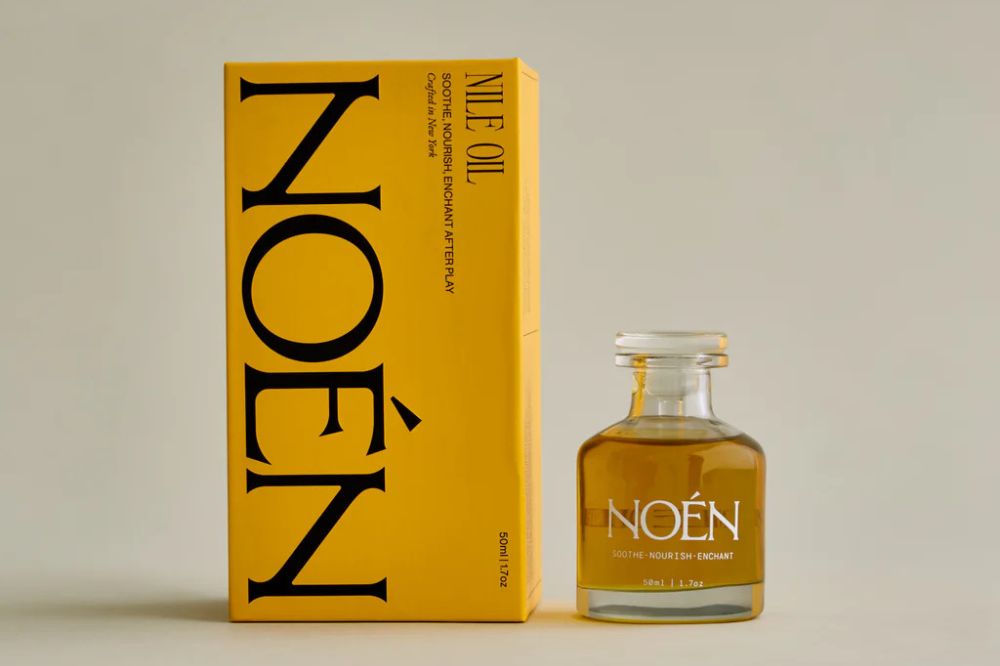
A ritual doesn't have to be elaborate. Sometimes it's as simple as oil, breath, touch. Our Nile Oil is one of those quiet rituals that turns care into connection—softening skin, slowing the body, a...