
HOW A FRAGRANCE BECOMES A SIGNATURE SCENT
What if your presence was felt long before you ever arrived? A man is trying to hold on to a very specific element: the smell of moringa oil after it has soaked into fine linen. This is the only scent that matters to him because it evokes the particular scent of someone he loves.
Would that I were the launderer
Of my beloved’s linen even for one month.
I would thrive by touching [the garments]
Which had been in contact with her body,
And it would be I who would wash out
The moringa oil from her clothing.
Written by an anonymous Egyptian poet three millennia ago, these verses document one of history's earliest records of the interplay between olfactory memory, presence and desire. The existence of such visceral poetry in ancient Egypt reveals an early fascination with what we now call a signature scent.
That man wanted to be the one who washed the beloved's linen because he wanted to remain close to those fabrics where her scent lingered.

CHASING A TRACE…
Our sense of smell is wired unlike any other. While sight, sound, taste and touch reach the rational mind first, smell bypasses all filters and goes directly to the limbic system. This is where our brain processes emotional memory, arousal and attachment, the exact place where impressions like those from the Egyptian poet endure.
Yet this same limbic system does not merely archive memories and past intimacy. It constantly evaluates our biological present. In 1995, Swiss biologist Claus Wedekind conducted a landmark experiment about human attraction. He asked a group of men to wear the same plain cotton t-shirt for two consecutive nights, avoiding all scented products. He then asked women to smell each shirt anonymously and rate them for attractiveness. A striking pattern emerged: women consistently preferred the shirts of men whose immune profile - specifically the genes encoded in the Major Histocompatibility Complex (MHC) - differed most significantly from their own.
In evolutionary terms, this genetic diversity is the very definition of compatibility: the greater the difference, the stronger the immune system of potential offspring. Without a face, a voice or a single exchanged word, those women were reading biological compatibility through fabrics embedded with particular odors. What those women were responding to has no simple name. We tend to reach for the word pheromone when we try to describe it - that sense of being drawn to someone before reason has had time to intervene - but the reality is way more complex.
ON THE QUESTION OF PHEROMONES
Coined in 1959 from the ancient Greek pherein (“to carry”) and hormon (“to excite” or “to set in motion”), pheromone describes a chemical signal that travels between members of the same species to trigger specific social behaviors or sexual responses.
In the animal kingdom, pheromones are well-documented, but in humans not so much. Unlike many animals, we lack a fully functional vomeronasal organ, the structure through which pheromones are typically detected. This raises an inevitable question: if we lack that specific organ, why is science still trying to hypothesize the existence of “human pheromones” and studying compounds secreted by our skin?
Human sweat, for instance, has been widely researched. Initially odorless, fresh sweat acquires its character through contact with the skin's natural microflora, producing, among other compounds, androstadienone. And a deeper look at it reveals why human attraction is so nuanced. Present in significantly higher concentrations in male perspiration after puberty, androstadienone alone, in a controlled environment, is far from being a magnet of attraction. It is unremarkable, because many people simply cannot smell it at all - and those who can, rarely find it pleasant. But when perceived subconsciously within social contexts, something different happens: studies on chemosignalling suggest that exposure to this compound plays a beneficial role in women’s mood, focus and sexual response.
Androstadienone itself doesn’t trigger an immediate arousal, but it can set the stage for it. It doesn't force desire, instead it opens the door - and that is when a fragrance finds room to grow and come alive.
A SIGNATURE SCENT IS BORN
From subtle variations in skin pH to the unique bacterial landscape of our individual microbiomes, our skin actively interacts with each and every fragrance it comes into contact with. These daily shifts can push a scent warmer or deeper, brighter or softer.
Yet, some fragrances are crafted to engage in this dialogue in a different way. Where alcohol-based fragrances evaporate rapidly, carrying the scent away from the body, oil-based perfumes naturally bind with the skin's lipid barrier, slowing evaporation and allowing the deepest notes to develop over hours.

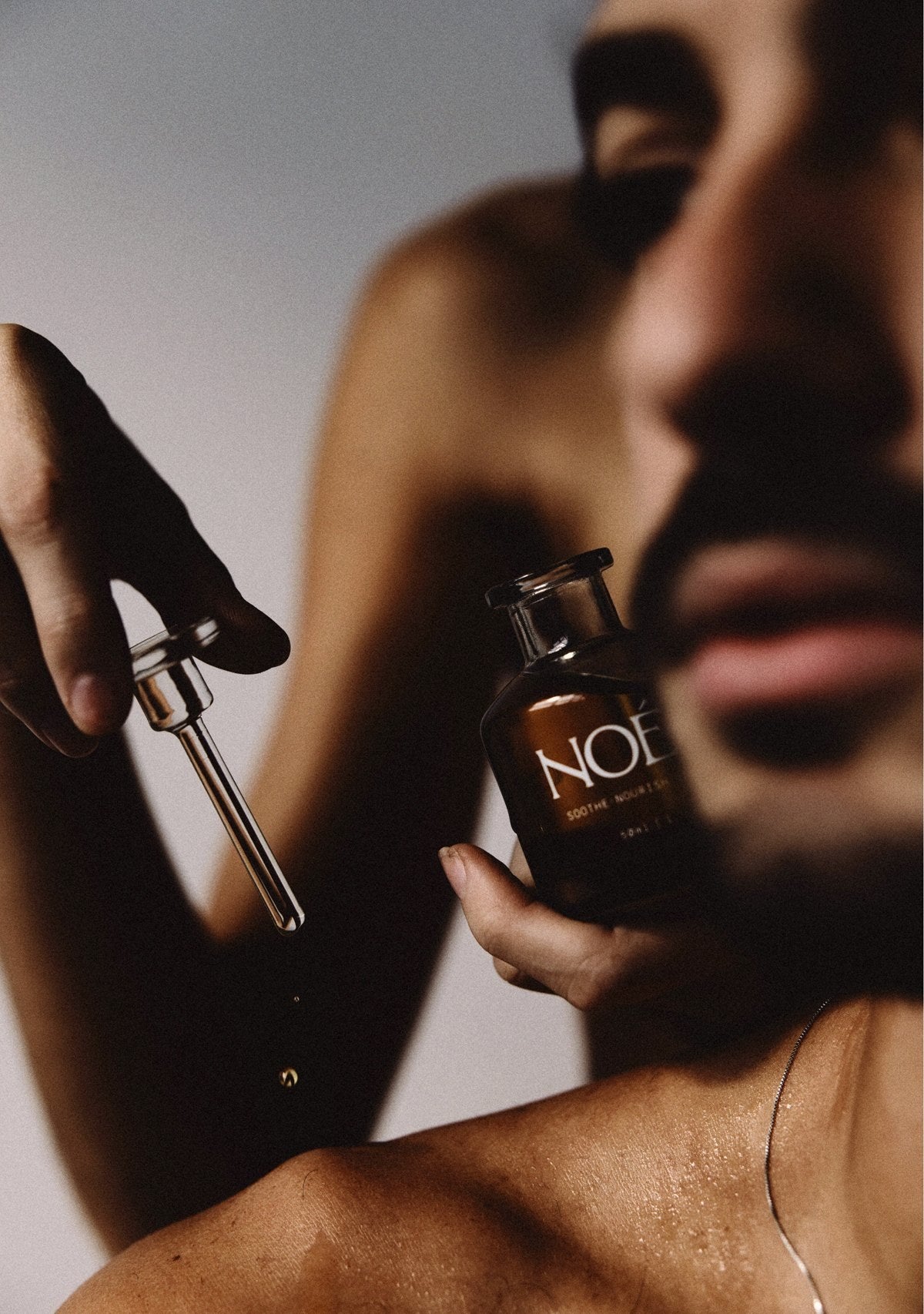
Dawn and Eros, our new aphrodisiac Perfume Oils inspired by the ancient Egyptian art of perfumery, were formulated with this in mind. By setting aside alcohol, synthetic fillers and artificial projection, we retain only what is essential: natural and organic botanicals suspended in Nile Oil, designed to melt into the skin and stay. For hours. For days. Forever, in the olfactory memory of someone who has held you close.
Each settles into the skin and begins a slow conversation with the warmth and chemistry it finds there. Dawn opens softly with jasmine and rose, giving way to neroli, frankincense and a quiet base of wood, earth and spice, while Eros begins with a flicker of bergamot before pulling into amber resin, velvet musk, blue lotus and vanilla-dark woods.
The formula inside every bottle of Dawn and Eros is the same. However, the scent that emerges is yours alone. A scent shaped by the skin you live in.
Read more

Inspired by the ancient Egyptian art of perfumery, this journal explores the forgotten ritual of scent as an act of presence, intimacy, and self-devotion. Discover how Cleopatra and the world's fir...

Intimacy cannot be rushed—it begins with returning to the body. Discover four daily rituals using Nile Oil, Dawn and Eros to slow down, awaken the senses, and create space for deeper conne...